Learning To Live With Excess Opportunity

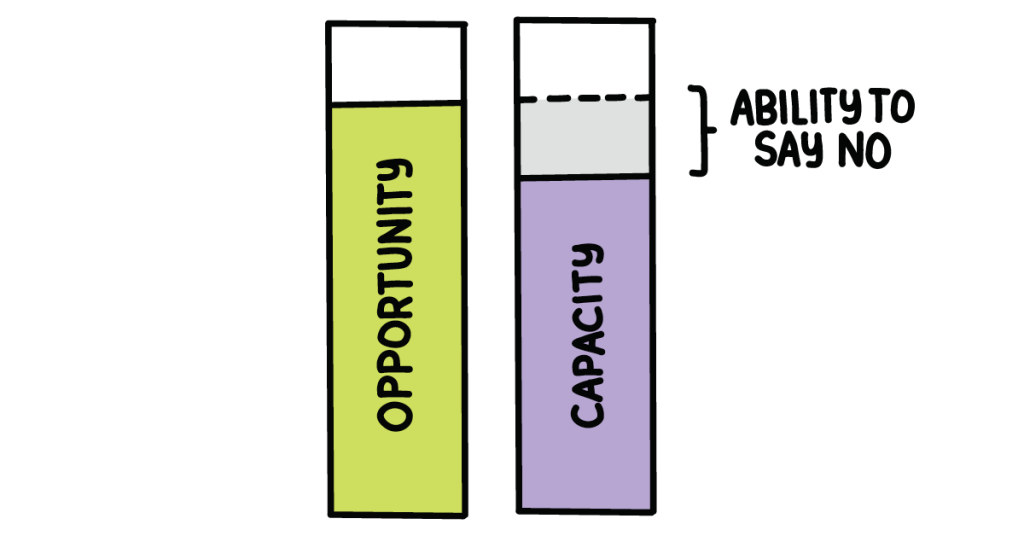
One of the biggest challenges in running a firm is balancing capacity and opportunity (or supply and demand). Your opportunity is clients who want to hire you, and your capacity is the amount of paid work that your team can generate.
But what’s probably become very clear to you as an entrepreneur is that you have way more control over your team size than your client demand, but also that it’s far more painful to pull that lever and to adjust team size, up or down. Adjusting it downward means someone losing their job; adjusting it upward means more financial risk and management responsibility for you.
An Entrepreneur’s Twisted Mind
I want to dive a little deeper into this and pull out one aspect of your personality that I think might not be doing you any favors (to be clear, I suffer the same thing), and that’s how you think about opportunity, and how that belief you have is trapping you in an endless cycle.
Your beliefs about opportunity look like this:
- I’m really good at turning opportunity into money. It’s what I’ve done since I founded this firm. Put me in front of a prospect and I’ll usually close them.
- I had a lot of opportunity when this firm started—which is what gave me the courage to start it in the first place—but some of those early wells have run dry.
- I create opportunity for my clients, but I’ve struggled to do it for myself.
- When opportunity does come along, I view it as rare and precious, and so I jump on it, close the deal, and make promises to new clients.
- That means I have to hire. I’ve thought about hiring in advance, but that seems very risky. So I’ve waited until I have the work, and now I need to jump on it.
There are two things you’re doing in this cycle:
- Thinking that opportunity is so rare and precious that you can’t waste it, On a side note, have you ever wondered why the USA is known as the “Land of Opportunity”? It’s in our DNA, and that’s why so many people want to do business here.
- Always then matching your capacity to meet your opportunity since you don’t want to turn any of it away.
But what this does, essentially, is trap you in this endless cycle of matching the two things: opportunity and capacity. Matching those two things so closely to each other can mess with people’s lives when you have to lay them off, while simultaneously putting everlasting pressure on you to produce new clients to justify the capacity that you don’t want to trim.
Learning to Waste Opportunity
What if you and I grew up a little, relaxed, and decided to leave some opportunity unmet? What if we raised prices, instead? Or were a little choosier?
The simple point I want to make, like you see in that illustration, is that your goal should not be to match those two things—opportunity and capacity—but to let one always trail the other. The “delta” (or “gap”) between those two levels represents your ability to say no, and that is the most underappreciated advantage that comes with being an entrepreneur: control. We have come to believe that the beauty of entrepreneurship is about saying yes, when in fact it’s about saying no.
So if you don’t want to chase work to support the team you’ve built, get used to another idea (or set of them):
- What size firm do you want to lead. In other words, how much do you want to be in the people business? Where are your strengths?
- Decide on the hiring strategy, recognizing which of the three phases you are in.
- Learn to say “no” to opportunity that steers you off that trajectory.
We hate to say “no” to opportunity. Some of us freakin’ live in the land of opportunity, and it’s unpatriotic to turn it down! But the gap between your capacity and your opportunity represents your ability to say no. And saying no is what keeps you sane (or saner, for some of us).
Or, use contractors. Or send work to another firm when they are a better fit.
You don’t need to say yes to everything. This is your firm. Make sure it doesn’t become someone else’s because of the decisions they are making on your behalf.