The Waterfall of Differentiation

There's a 2Bobs episode on this topic if you're rather listen than read.
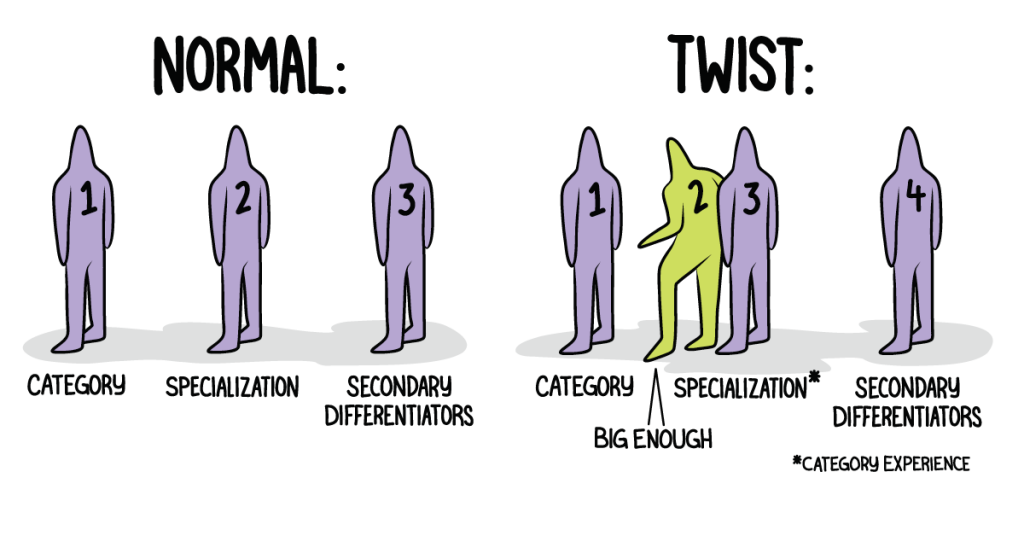
After reviewing the positioning of 1,300+ firms and writing books and articles on the subject, I’m still puzzled at one thing that people keep getting wrong. This could be my fault, too, because—until now—I haven’t found the best way to describe this phenomenon, and then Emily came along and crafted the perfect illustration to capture the concept.
There are two things I want to address. The first is how you can’t get the three steps of differentiation out of order, and the second is how being a larger firm inserts an additional step in the process.
What We’re Aiming For
I guess I should make the whole point of positioning clear, too. It does three things for us:
- Better work for clients because we see the patterns.
- Easier marketing because we have a clear target.
- More money because there are fewer available substitutes.
It does other things, too, like providing direction for our service offering design and a half dozen others, but those three are the key ones.
If we look at this from a numerical standpoint, you really want to apply an early dual test before you apply the large bank of tests. You want a positioning that yields 10–200 competitors (crowding the lower end of that range) and 2,000–10,000 prospects (crowding the higher end of that range).
There are times when those two tests don’t overlap as they should, but those are edge cases that I talk about in the book. For now I’ll say that too many prospects and too few competitors indicates an unsophisticated market, while few prospects and many competitors indicated a pre-efficient market.
Now let’s walk through the waterfall of differentiation, starting where we should and not getting ahead of ourselves.
Question No. 1: Category
You aren’t deciding something here. It’s already decided for you. It’s whatever you wrote on the tax form for NAICS (SIC) code when you filed the paperwork.
You cannot invent something. If you aren’t using standard terminology, you’re going to lose the battle. We are an M&A and Advisory firm. You’re in marketing or advertising or design or public relations or software development or UX research or SEO or paid digital or whatever. (No, “digital” is not on that list. Everything is digital.)
This category choice is not what makes you special. It just is. It’s an identifier. I’m a human. Frida our Great Dane is a dog (she doesn’t know this and she has her own positioning issues).
So is the first stop on the flow over that waterfall. But before I go to the second one, please humor me for a moment about this “category creation” nonsense I see all over LinkedIn.
By definition, there is only one entity that creates a category, and that’s the first one. There’s one Uber, one AirBNB, and one iPhone. The rest were later entrants.
Quit pretending that you create new categories. Even if you did do work for Uber at one point, it’s a bit of an overreach to claim that you helped them create that category and can do the same for this new client. These overblown claims are exactly why people don’t generally trust the marketing field.
So you are in a category. You don’t invent one, but rather choose an existing one. None of us are big enough to invent a category for ourselves, but instead have to choose an existing one that resonates with the client. We don’t have sufficient clout to educate a marketplace on a new category. I would also be careful about the phrase “…at the intersection of x and y” too, as that skirts the category creation error.
Question No. 2: Specialization
Specialization is essentially how you differ from the other firms in this same category. If there aren’t other firms in the same category, it’s not generally a category but you are trying to invent one (see above). If there are too many others with your specialization, it’s not really a specialization.
You have two options, here, but broadly speaking you are describing your specialization as what you do for whom, but you emphasize the WHAT if it’s horizontal and the FOR WHOM if it’s vertical:
- Horizontal (emphasizes WHAT you do for whom)
- Demographic (old, black, rich, urban, educated, leaders, etc.)
- Tight service offering design (IR, recruitment, etc.)
- Vertical (emphasizes what you do FOR WHOM)
- By industry
This narrows the consideration set down further (that 10–200 number, above). I’ll pause here and note the major error that some in the profession are espousing, and that’s to claim that a true specialization can only be vertical (i.e., tied to an industry). It’s simply not true, and not even close to true. What is true that the major challenge of a horizontal positioning is addressability, but if you can solve that issue, a horizontal positioning can be even better than a vertical one.
So now we have a category and a specialization, but our positioning work is not yet done because we want one firm (yours) to be the logical or emotional choice.
We need a way to distinguish you from the other firms who are also qualified as specialists in this vertical or horizontal. That’s where the next differentiator comes in.
Question No. 3: Secondary Differentiators
This is the only one of the three where many other options exist. Many times it’s a combination of items, too.
Examples:
- Some proprietary IP.
- Data-driven research methodology.
- How the service is delivered: staff aug, leasing entire teams, etc.
- Pricing uniqueness.
- Onboarding and portals and process. A diagnostic or workshop would fit under this category.
- Productization.
I’ll end this section by noting another major mistake firms make: they correctly list the category, skip the specialization, and then claim that their way of working is sufficiently unique to yield a tightly positioned firm. More on that in this article.
Finally: An Interesting Twist
So normally, it’s:
- Category
- Specialization
- Secondary Differentiators
But in the case of larger firms (typically >45), another characteristic jumps the line and trumps everything else that follows: the firm’s size, and how the prospective client can only work with a firm with a sufficiently deep bench that justifies the trust that this will get done. It’s especially common in these instances:
- Multinational work
- Huge dev projects
When this is true, the order looks like this:
- Category.
- Big enough.
- Specialization.*
- Secondary Differentiators.
*And this specialization is often referred to as “category experience” and is one of multiple “categories,” all housed under one roof.
The Dead Objection
While firms are getting dragged, kicking and screaming, across the specialization line, they will often cite this exception as why they don’t need to be tightly specialized:
“Look at (big, famous firm). They aren’t specialized, so why do we need to be? Our work is as good as theirs, and we aspire to be another (that big, famous firm).”
The problem with that argument is two-fold:
- That firm has usually skipped the line with connections and confidence, which is always possible.
- They are big, and that trumps specialization.
Sure, you can skip the steps. But there is not (yet) a GLP-1 drug for specialization. I’ll let you know when one emerges.