Understanding Earnouts

If/when you sell your firm, it’ll likely be the largest transaction of your life, and so it makes sense to understand it! In this article we’re going to give you a crash course in everything earnouts.
Full Price Paid in Cash?
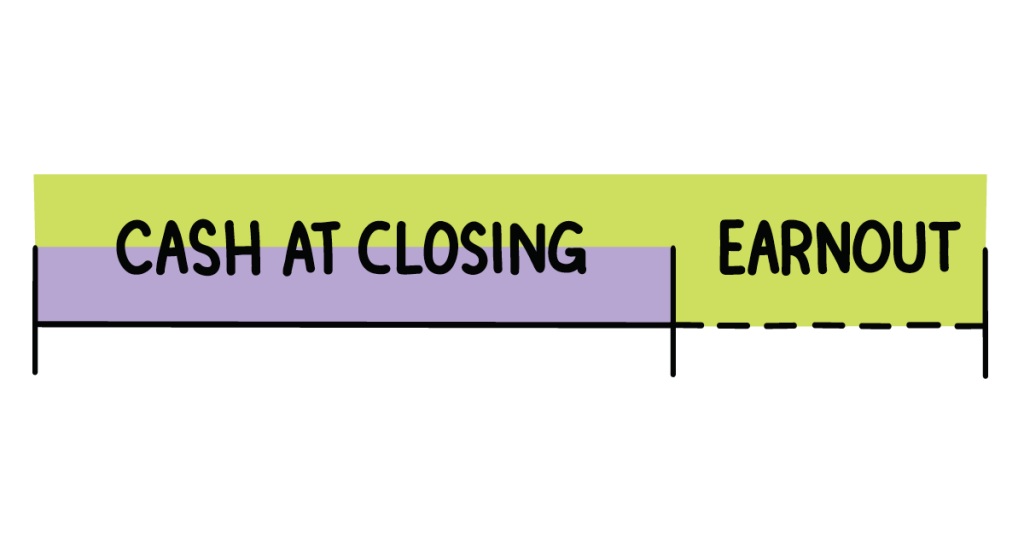
Think of an earnout as the conditions under which you’ll get all the rest of the money that is not paid to you in cash at closing. In some transactions, the purchase price is paid entirely at closing; in other words, there are no conditions that will or will not be met later after the firm is sold.
Even so, getting paid in full when all the papers are signed is quite rare, though it happens, and the triggers for it make sense. Maybe it’ll be very difficult to track the performance of your firm afterward because you’ll quickly be integrated into the buyer’s firm. Or maybe you’re being purchased by one of your own clients, and they expect your other clients to abandon you, slowly, over time, and don’t really expect you to recruit new clients that will in effect be competitors to the acquirer. We even did a transaction, once, where the seller was being appointed to a high government office, the terms of which didn’t allow any conflict of interest involving an ownership position in a business that might involve the government, and so there could be no earnout because his actions might influence the outcome, one way or another. And finally, you’ll sometimes see that the seller is moving on, by choice or because of some health issue.
But for most transactions, most of the price is divided into some amount of cash at closing and the remainder during an earnout.
History of the Earnout
For the record, the earnout is a fairly modern concept that’s now widespread. Earnouts first appeared in the 1980s, and were then widely used in the 1990s and beyond. Their rise reflected the use of acquisitions as a business tool, and the fact that those acquisitions carried more and more risk for the buyer. They allowed the buyer to pay higher prices to the seller, but still shift some of that risk to what actually happened after the transaction closed.
With that wider use of earnouts came more scrutiny from accounting bodies, which wanted to ensure that buyers were properly disclosing everything they were on the hook for after the transaction. This helped make earnouts more transparent and, hopefully, predictable. Then, as you would expect, earnouts were challenged in court, putting more pressure on how they were spelled out and calculated. There is typically a direct relationship between an earnout’s structure and the uncertainty that a buyer has about what’ll happen after the transaction closes.
Elements of an Earnout
An earnout will address these things:
- The formula for calculating the payment(s).
- The time periods for that calculation.
- Any dependencies (what has sto happen for you to earn it).
The formula is mutually agreed upon, but the earnout is an offer from the buyer and will reflect what’s most important to them. Everything they pay to you in cash at closing is gone, forever, and the earnout is both a mechanism to derisk the remaining portion of the purchase and a very specific incentive for the behavior they want from you.
(This isn’t entirely true in that some of the cash paid at closing might be deposited into an escrow account, which is trued up later, but that’s really just an administrative thing to make the demands of due diligence less onerous.)
The recent trend in earnouts has been to simplify them and tie them to the most important thing the buyer wants, like continued growth, profitability, or something else. But in rare cases you will still see complex earnouts.
The unit of time is almost always a year, and the number of units is almost always 1, 2, or 3 years. Five years was standard in the past, but you’ll hardly ever find an earnout that lasts that long. The world is changing too fast.
The dependencies are simple requirements that will trigger an actual payment for meeting the earnout’s goals. This might be something like your continued presence, not being charged with a felony, adherence to a noncompete, etc.
Let’s go into this in more detail.
Understand the Incentives
“Show me the incentives and I’ll show you the outcome,” Charlie Munger famously said. While it’s certainly fair for the buyer to load up an earnout with incentives to achieve certain goals together, there’s also a diminishing return in relying too much on them. Here’s how a conversation might unfold.
Buyer: We’re excited about buying your firm. Our main, and almost singular, purpose is to help build our HR consulting practice. It’s not something we do now, and we think there’s a lot of opportunity there. We’re beyond excited.
Seller: That’s great. I see that you’ve built up a change management practice, too. How’s that going? And do you see any cross-selling opportunities between the two if we make this work?
Buyer: Great question. It’s going well, but maybe not as well as we had hoped. There’s a bit of room for improvement. We had some management changes along the way and lost a bit of momentum. Actually, they could probably learn a lot from you and how your team has maintained a really consistent growth trajectory.
Seller: Uhm. Yeah, I can see that. But let me ask a question. The earnout that you are proposing is tied exclusively to how my new department is performing, which is why you want to keep separate books so that both of us can track how well we do after we’re brought into the mothership. I can see how it’ll be natural—and probably a good idea—for me to be involved in guiding the change management group, cross-selling their services, helping them close big deals for that department, and so on. I’m a team player, for sure, but I’m worried that I’m kinda not going to have the financial incentive to do anything but focus on my own department. Any way we could address this?
And then the conversation starts, because the incentives are pretty much going to guarantee the outcome. Maybe the incentive is tied instead to the overall growth of the company and not just your department, in which case you’ll have your own questions about how much is in your control or not. Or maybe it’s split. Or maybe it’s removed entirely. Incentives can be a good thing, but they can really be bad, too.
When I think of incentives, I think of that time in a science lab in high school when the teacher paired me with great students or loser students. Under my breath, I was saying, “Geez. I ought to just let these other three fellow students gossip while I do the real work.” Or, “This is fantastic. We can divide and conquer and crush the other teams with our collective strength.”
There’s a psychological element to this, too. The more complex the incentive arrangements, the less motivating they are. If I want Frida, our 160-lb Great Dane, to bring the ball back and drop it at my feet, I’ll give her a treat to do it. I’m not going to tell her she has to do that within 2.5 seconds or she doesn’t get a treat. No, drop the ball and get a treat. (Hit this simple target and get the earnout.) For the record, she never drops the ball, so this is purely a hypothetical. And while I know a lot about incentives in earnouts, I clearly know nothing about how to construct earnouts with dogs.
Careful What You Promise
It’s pretty easy to make promises meant to put the buyer’s mind at ease about something, but it’s really, really important to remember how quickly these can bite you in the butt.
Imagine a conversation unfolding like this:
Buyer: Hey, your most recent full year was actually really good. Strong growth from the previous year and you added eight percentage points to your EBITDA. That’s the kind of performance we’re looking for, and we want to make sure it’s not an aberration from the previous two years, which were kind of flat. What’s your thinking on that?
Seller: Fair point. We were initially worried about the same thing, but here’s why that was not a one-time thing but actually the new normal. [Blah, blah, blah … lots of BS promises and hype.]
Buyer: Ah! I see now what you mean. [Gives understanding look to their partner, sitting across the table.] Let’s do this, then. How about we build that assumption into the earnout. You seem confident that you’ll maintain this level of performance and we’re very happy to reward it.
Boom. You just got took, as they say, because now they’ll make you eat your words. The buyer rightfully expects you to make projections, but don’t make projections that are so damning that they make you eat them in an earnout. Don’t write checks in your early discussions that you can’t cash in an earnout.
What Earnouts Are Tied To
As you would expect, earnouts can be tied to anything that’s important to the buyer. In an ideal world, the earnout is tied to the purpose of the acquisition, and it’s pegged to that simple metric. Say the acquisition is being tied to added EBITDA, which is darn easy to measure, so tie the earnout to that but don’t let them tell you how to achieve it.
You’ll find earnouts most commonly linked to these things:
- Top-line revenue targets.
- Profitability targets, either measured by net revenue (before EBITDA allowances are made) or just purely EBITDA targets.
- Growth trajectories, like maintaining a 20% YoY target.
- Retention of a particular client, especially if your revenue has come in part from a client concentration risk (i.e., one related source of revenue is a higher percentage than the buyer is comfortable with).
- Milestones that might deliver continued success: regulatory approval, rolling out a product or service on time, etc.
This is where you might want to retroactively model this out, either using your own team to do it or the buyer’s financial people. This will help you see what would have happened if, say, events had unfolded differently in the past. It will also confirm how the buyer is going to calculate it, which is an argument for having them do that for you.
Cliffs vs. Graduated Targets
The LOI, or the later purchase agreement, might arrive on your desk with cliffs for hitting performance targets. “Achieve a net profit of 18% and you’ll get an additional $160,000 payment at the close of the annual reporting period, no later than 60 days following that close.”
When you read that, your first thought should be: What happens if I hit 17%? And thus will begin the very necessary negotiation to replace those cliff targets with graduated or sloped targets. The ideal adjustment would be something like this: The 18% target will be paid proportionally. In other words, achieving a 9% net profit will result in receiving one-half of the $160,000, or $80,000.
That’s probably not what’s going to happen, but you absolutely must protect yourself in the event that you get close to the target but don’t actually hit it, ensuring that you get something and not nothing.
Failing some reasonable resolution, your last best option is to retain the right to make up that goal deficiency in the next period. Say you miss it in the first period, by just a little bit, but blow the goal out of the water in the second period. Maybe any excess performance they aren’t going to give you credit for could be applied retroactively.
In that same vein, you want to be careful about maximum ceilings. Say you negotiate a sloped sort of arrangement like I’ve just suggested, and you’re eligible to earn more than the $160,000 (using the same illustration) if you achieve a net profit greater than 18%. If the negotiations start to get weird—because there definitely is a diminishing return in arguing about everything—just explain that you just don’t want any incentives to manipulate when revenue hits the books, which is exactly what’s going to happen if they get too cute in the targets you need to meet. More on that later.
Role of Employment Agreements
In simple terms, you need an employment agreement, and it needs to match the length of the earnout. This fact will give you one piece of ammunition, among others, in negotiating a shorter earnout, because they’ll be stuck paying you during the entire term of the earnout and they may want more flexibility than that.
Here’s why that’s important. Picture a transaction where 70% of the purchase price is paid in cash at closing, with a 2-year earnout during which, if you hit reasonable targets, you’ll be paid another 15% at the close of each year.
But your boss leaves after 9 months, or they acquire another company, or there’s some big downturn, or they just don’t like you, and for whatever reason they fire you, and the “cause” (or “reason”) isn’t something you agree with.
When that happens, not only will you lose your salary and benefits (and possibly your dignity), but you’ll be untethered from this company, and you’ll have zero influence on whether or not the department—your former company—left behind can perform in such a way that the earnout is achieved. You’re sitting over here watching your kid driving the car and who knows what they’ll hit. Scream all you want, but you’re powerless.
That’s why a matching employment agreement makes sense. It not only protects your earnout, but also your compensation, your title, and your responsibilities. In a good setting where there’s reasonable people all around, you’ll work with them if those things need to change, but you need some legal leverage, which you might willingly give up, later, if it’s truly in your best interest to do so. You absolutely need to work with an attorney on this. An advisor might be able to outline the basic tenets, but this requires an attorney’s mind to shape it in a way that’s enforceable in whatever jurisdiction is chosen for disputes (these things vary a lot by jurisdiction).
One last thought: You may not think too much about this, now, but keep in mind that you may very well need some carveouts to whatever noncompete is sandwiched with the employment agreement, and these fall into two categories:
- The things you are already doing or intend to do that don’t strike you as a competitive activity, but which you want to clear with the buyer. These might include serving on a board, donating your expertise to a nonprofit, etc. Just raise them and get their approval, preferably in writing.
- The things you will want to do if/when you leave employment, regardless of the circumstances (for cause or otherwise). Say you have a noncompete that prevents you from starting another competitive firm, owning part of a competitive firm, or even working at one. Maybe you feel like you have to agree to this in order to drag the purchase across the finish line. Here the obvious carveout is to be able to accept a job on the client side rather than the firm you are working for, now. Maybe it’s not for a client currently being served by the buyer, but you need to give yourself options, even if you aren’t sure you’ll need them.
One of those options deserves its own section, and that’s to be prepared for the very rare case where something goes terribly wrong. That’s next.
The Big Reversal
Every purchase agreement (that’s the last thing you sign, after the LOI and due diligence and any final adjustments) will spell out what happens if either party doesn’t meet their obligations.
For example, let’s say the buyer defaults by not remitting an earnout payment to you. They have a certain number of days to do it and they miss the target. You can bend with them (at your own peril), or you can perk up and pay attention. You’ll typically have to give them written notice that they’ve defaulted (not met their promises), and the buyer will have the opportunity, then, to cure that default (keep their promise, retroactively, maybe with a penalty) within a certain period of time.
But what happens if they don’t? If a buyer misses some major milestone—and this is especially true if there’s a significant penalty attached to that—something is probably seriously wrong, and here’s where you need to protect yourself.
Here’s our standard suggestion when negotiating purchase agreements: You keep everything you have received and are released from any noncompete. You’re still going to lose, because you have to start over. But at least you’re free to do what you want, including taking any legacy clients with you, and you don’t have to sell the boat you bought with the money you collected at closing and repay it to them. (I guess you could just park the boat in their front lawn, but doing that late at night carries its own risks.)
Summary
When you analyze the earnout, here are the things to look at:
- Does it incentivize the right things?
- Will it be easy to calculate?
- What will happen if I don’t hit the desired target?
- Will it allow me to derisk my ownership of this firm?
This last point is probably the most important one in the entire chapter. If the earnout means that you’ll retain nearly all the entrepreneurial risk you have now—but with a boss who will have a fair bit of control over your activities—why not just go it alone and keep all of the upside rather than carrying on the good fight for someone else and keeping just some of it?
One of the main reasons you started and are running your firm is that you’re basically unemployable, except for this brief period of time otherwise known as an earnout. So if you’re going to subject yourself to having a boss again, by all the good things that grow on God’s green earth, you’d better be compensated for stepping back into an employment situation again, and that’s what an earnout is.
If we can help you with a valuation or any sort of transaction, including buy- and sell-side searches, just reach out and let us know.