The Single Trait that Successful Entrepreneurs Share

Below, I’m going to talk about the one single trait that 99.7% of successful entrepreneurs possess, based on some proprietary research we’ve done, but first some background.
I find scientific personality theory very interesting (but see a disclaimer at the end). While every human is truly unique, there are some expected tendencies that we can see across the basic fifteen subtypes of how people think and act. For reference, we at Punctuation have personality profile results of more than 30,000 people in this field, from all over the world, and covering every position in advertising, design, public relations, and dev work. Those results paint a fascinating picture about which people are more naturally inclined to love certain types of jobs and tasks. It’s not that they can’t do the others, but they pull energy from them.
That leads to an important element of personality theory. Doing something that’s not a natural fit for who you are drains you like a disconnected battery on a cold day trying to crank a freezing engine with molasses-like oil. But doing something that’s a natural fit for you is like firing up an F1 engine on a hot day and speeding off in the absolute flow of things. It’s not about disqualification but about fit.
Four Big Categories
The deeper you go into personality profile research, the more exceptions there are, and you’ll be on thin ice if you get caught up in thinking that they are always predictive. But back away and look at the big picture and the data is very interesting.
Here’s an example of grouping people into four large buckets. They aren’t exact, but they help to put things into perspective. I’m going to use the language of DiSC, here, but it can be translated into the other tools. You can view each of these four types across two axes: one is how they see the world, and the other is what role they might play in influencing it.
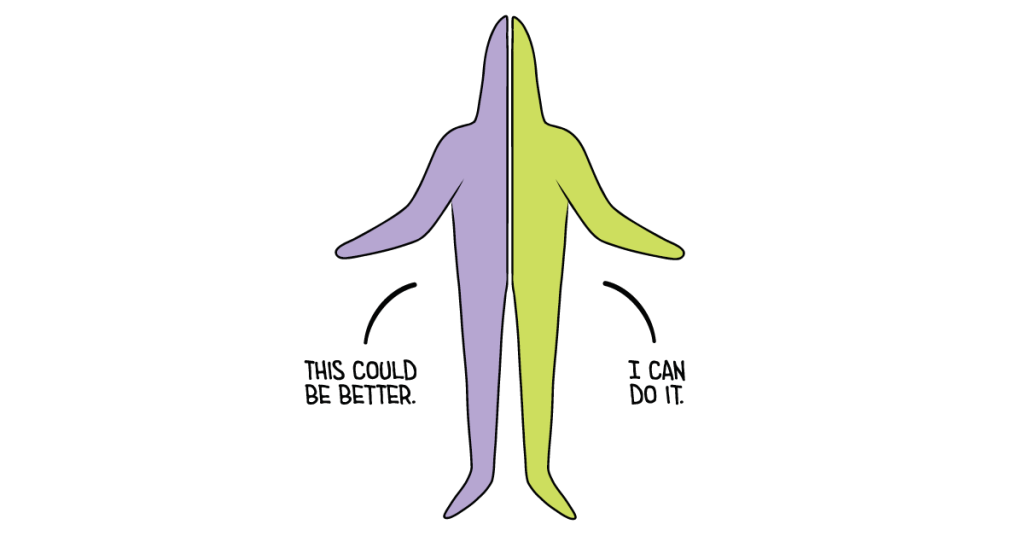
- A “D” personality (dominance) looks at things and believes that circumstances could be better. And that they, individually, have the power to change things. “This situation could be better and I can fix it. I’m more powerful than this environment and I’m not going to be constrained by it.”
- An “I” personality (influence) believes things are pretty good, but they could be even better, and they are up to the task of improving things. They actively shape outcomes and persuade others to help with enthusiasm, but they start from a different perspective (this is good vs. this sucks).
- An “S” personality (steadiness) sees the environment as generally favorable, and that’s a good thing because they don’t generally believe that they can impact it, so they just adapt to it instead and do very well in the process.
- A “C” personality (conscientious) generally sees the environment as challenging (unfavorable), doesn’t think they have much control over it, and simply adapt instead and live with it.
Here’s another way that it’s often summarized:
- D and i believe they can influence their environment (active/outgoing)
- S and C work within their environment (reserved/cautious)
- D and C see challenges that need addressing
- i and S see favorable conditions
That 99.7% Equation
Okay, now I want to get to the heart of this particular article. There is one characteristic that all but 3 in 1,000 successful entrepreneurs share. Deep into a research jaunt where we’d already spent more than $300k to find common personality traits in account managers and project managers, we realized that we were sitting on a goldmine of data about successful principals, too.
So back to SPSS (the analysis software) we went to see whether there were any patterns in the personalities of successful entrepreneurs who were running these firms, and there was. Of the successful firms we’d studied, only about 4 of the 1,340 did not have a significant aptitude for risk (above 50th percentile, and often way above it).
Here’s another way to look at that. Successful principals can be outgoing or introverted—it doesn’t matter. They can be objective or struggle with that—it doesn’t matter. They are often not very process oriented, but there’s an interesting corollary to that: they are pretty eager to establish processes and protocols for others, while not following those processes themselves. Hah.
But what matters is that they are open to making decisions that carry some risk, around people, clients, service offerings, culture, and even finances.
The Exceptions
The few exceptions to this were the deep, badged experts with good connections. They succeeded without much risk taking. So that’s one exception, but it’s very rare.
The really important exception, and one that occurs often, is this: only one of the partners needs to have an aptitude for risk. You can see some of this in firms that use the EOS model, with the Visionary and the Integrator. The Visionary is the risk taker and the Integrator tethers that helium-filled balloon to earth to think things through before launch.
Regardless of those exceptions, it’s almost always the high-agency people who thrive. They are not victims, and obstacles are there to be solved. These remarkable high-agency people believe they can shape circumstances rather than be defined by them.
Your Personality and M&A
The same personality characteristics that give you the innate skills to build a strong entrepreneurial firm can sometimes be an obstacle when you sell your firm and work for someone else during the sentence earnout. This stems from your unemployable self.
The good news is that the earnouts that we help craft for you are almost always going to use your strengths. We work to build carveouts that are unique to each situation, put you in charge of things that’ll continue to raise your profile, all the while helping you reach those earnout targets and be ready for whatever is next.
But until then, keep taking (smart) risks. In my thinking—and this should be a bumper sticker—"high-agency principals happen to things (and not the other way around)”.
Personality theory is interesting and directionally helpful, but the science is not indisputable, people act differently at work and at home, and certain life circumstances can skew the results. But they are still helpful and we incorporate them in our Total Business Reset and Structuring Roles work.