Spontaneity is Calling—Don't Let it Go to Voicemail

Seems a bit strange that the guy who wrote the book on benchmarking and established many of the standards for the industry would suggest that you should ignore them sometimes, but that’s exactly what I’m going to say.
We—including me—have taken a lot of the fun out of this industry. As attribution becomes more and more out of reach and competition heats up, we’re terrified to “do our thing” and just wing it. But everybody, or nearly everybody, is following the same playbook, so maybe it’s time to deviate a bit.
When I’m personally focused on “performance,” my email list needs to grow organically, even as I lose 0.15% with every send. Open rates need to stay within a range. I need to sell out every event. My PowerPoint decks for every speaking engagement need to sizzle. Books need to sell more every subsequent year they are in the market.
It’s Exhausting.
Yes it is, and there’s actually a pretty strong case for:
- Understanding the benchmarks and following them usually.
- Violating them with careful choices to stand out.
I was reminded of this early this year when listening to a podcast episode by Derek Thompson called “How Metrics Make Us Miserable.” It’s part of his Plain English podcast and it’s worth a listen.
Now, in most evenings, I need to get my email inbox to zero, open any packages that came, do some chore I’ve saved to the end of the day, eat dinner, make my one cocktail, and then settle in for the next episode of whatever.
This is a far cry from how we lived as a young couple with two young boys in Winona Lake, IN. We had no TV, social media wasn’t a thing yet, and we just took walks after dinner around this little town of 5,000. That in itself wasn’t unusual, but what we did on those walks was: we dropped in, unannounced, to one of the two dozen families we knew. They weren’t expecting us and we had no plans—it was just spontaneity. And they, too, would drop in at the $15,000 bungalow we were so proud of.
Applying This with Terror
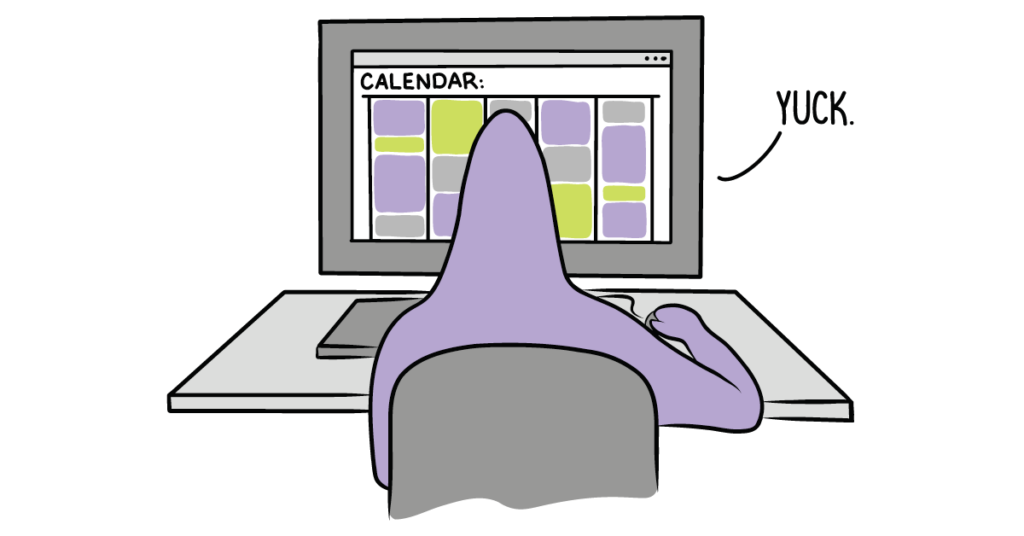
That spontaneity has been swapped for complexity and dashboards and careful planning. If you want to chase things, there’s no shortage of things to chase. It’s all measured, and someone like me is telling you how to measure up. But maybe we’re on the wrong track.
What do I mean by that? Maybe you don’t need to be on LinkedIn at all. Maybe one amazing article a month is better than a weekly shorter one. Maybe that boring as hell standing meeting has become pretty useless.
Maybe you don’t need to offer references or case studies. Maybe every employee, from the first day, should get a one-month sabbatical every year, on top of vacation. Maybe the team is only allowed one standing meeting per week. (These are all real examples, by the way, and I have clients who do each of these things.)
You could do things differently and not chase all the same “best practices” that you’re reminded of every day. Here’s something to that effect from Bob Hutchens (“Spontaneity is Calling; Should I Let it Go to Voicemail?”):
Showing up unannounced at a friend’s house is almost taboo.
This shift didn’t happen overnight. I’ve watched it evolve over the years, as our social norms quietly transformed. What we once saw as friendly is now intrusive and rude. We’ve created a complex dance of digital scheduling. Every interaction must be planned and confirmed. Sometimes, it must be rescheduled multiple times before it happens.
Don’t let spontaneity go to voicemail. Instead, answer it. Push through the terror and live a little bit more dangerously. Call someone up without it being on their calendar.
Looking to the Past
David Ogilvy figured this out 60 years ago (from “Confessions of an Advertising Man”):
The majority of business men are incapable of original thinking because they are unable to escape from the tyranny of reason. Their imaginations are blocked.
I am almost incapable of logical thought, but I have developed techniques for keeping open the telephone line to my unconscious, in case that disorderly repository has anything to tell me. I hear a great deal of music.
I take long hot baths. I garden. I go into retreat among the Amish. I watch birds. I go for long walks in the country. And I take frequent vacations, so that my brain can lie fallow — no golf, no cocktail parties, no tennis, no bridge, no concentration; only a bicycle.
While thus employed in doing nothing, I receive a constant stream of telegrams from my unconscious, and these become the raw material for my advertisements.
But more is required: hard work, an open mind, and ungovernable curiosity.
Benchmarks and metrics measure important things. But there are other things they don’t measure, and we need to get comfortable outside of this constant metric-chasing.