Crumbling Moats

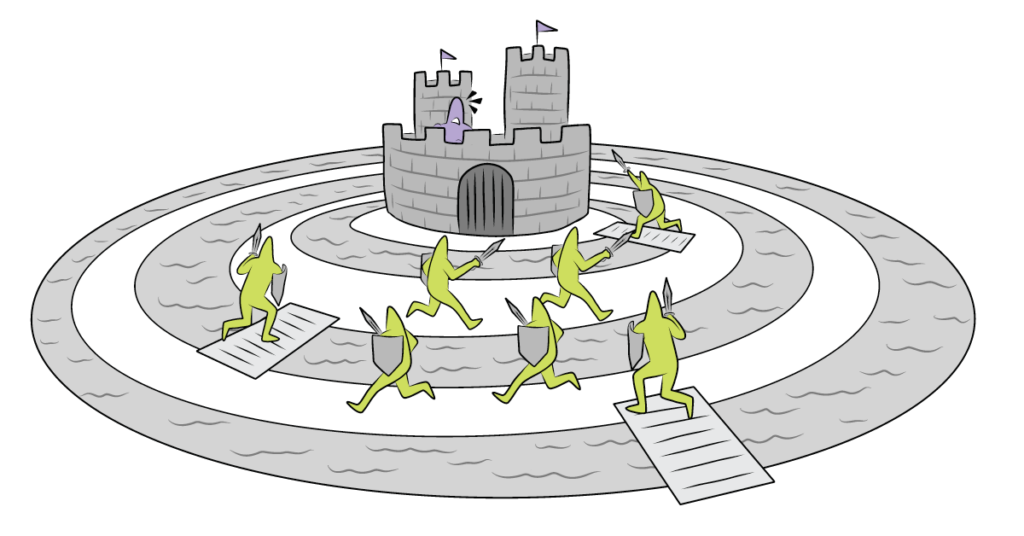
Many of the moats around your castle have fallen into disrepair, letting competitors get closer to storming it. Two of those crumbling moats have had far bigger impacts than the rest, but before we get to them, let me list the smaller ones.
The Smaller Crumbling Moats
When I look over the history of this field I so adore, here's what I see, in rough chronological order (the dates are estimates):
- 1974: Direct advertising disrupted cable TV
- 1975: Media was sold directly to clients rather than exclusively to "recognized agencies"
- 1980: In-house departments proliferated to buy that media directly and to protect brand standards
- 1985: Desktop publishing displaced typesetting and separations
- 1987: Software tools (e.g., Adobe) were democratized
- 1988: Far-shoring arrived, especially for development
- 1991: Avid disrupted film and video editing
- 1996: The internet eliminated the geographic moat
- 2005: Far-shoring was cemented by the dot-com buildout of internet infrastructure
- 2009: Programmatic advertising began bypassing agencies entirely
- 2010: Near-shoring grew to offset far-shoring's rising costs and time-zone issues
- 2023: AI finally began to disrupt advertising deeply
- 2024: Coding agents became widely used, three years after GitHub Copilot got a toe in the door
- 2025: Meta and OpenAI publicly aimed to disintermediate agencies
Earthquake No. 1: the Internet
This first one is hard to see if you've never worked without the internet. But the internet erased the geographic moat. Before it was widely used, your clients were local. Potential clients looked around town, and those were their choices. Your growth was limited by the concentration of companies in your metro area.
Once the internet opened up the world, you could work with any client you wanted, and any agency could pitch your clients. The world also became more complicated, generalist firms began a long slide toward irrelevance, and everything changed.
Earthquake No. 2: AI
All the smaller changes listed above mattered, but the big one at the other end of this daunting list is AI. It has reshaped both marketing (strategy and execution) and software development, which has long found a home under marketing because of digital transformation. There is no such thing as digital marketing: it's just marketing. So how do we understand AI's impact?
A Look at the Future
We know what the first change (the loss of the geographic moat) brought:
- Deep specialization, as clients were free to find better matches for their needs.
- A more complicated world, where products and services could be marketed globally.
- Less geographic relevance for your positioning. You didn't need to be in Cincinnati for F&B, Chicago for packaging, or Northern California for healthy food. The final nail in that coffin was the pandemic-era diaspora of teams, after which we aren't even sure "where you are" anymore.
But what about the second? I'm sticking with my original prediction, which has two parts: strategy will be deeper and better, and we will do more implementation for the same money. In other words, clients will ask for more work, not lower prices.
What else? Here I'm guessing rather than certain, but I'll give you some ideas:
- Firms will be smaller.
- Firms will be even more specialized.
- Offshoring will thrive at first, as agencies rely on technically advanced firms to fill the AI gaps where they are behind the curve. Eventually, though, offshoring will settle to a lower water table, consolidate, and go more client-direct. AI-driven work will move back to the US, and large AI firms will go more client-direct as agencies grow more sophisticated.
- A small minority of firms will get the team back together and work in concert.
- High-touch, truly personalized outreach will thrive.
- Direct mail will arrest its descent and be more in the mix.
- Great creative will rise again, finally, and cut through the nonsense. That will happen on the margins, though, not across the board.
- The big story is that marketing and advertising, as a whole, will be a career you choose for financial rather than creative reasons. Firms will be started with the express goal of selling them after 5–10 years, not at the end of a career.
- Hourly billing will crumble even further, replaced not by value pricing but by subscriptions to capacity and tool usage.
- Valuations will split in two. Specialized firms with real IP or proprietary data will get higher multiples. Generalist execution shops will struggle to find a buyer at any price. The buyer's question will shift from "What's your revenue?" to "What can't AI copy here?"
- The pipeline for junior staff will break. The production work that used to train juniors will go to AI, so in 10 years firms will struggle to find senior people. A few firms will treat apprenticeship as a deliberate investment, and that will become a moat of its own.
- Trust will win and keep clients. As a client, I want someone with impeccable judgment looking over all the work, from strategy to the final dotted i.
- Platforms will conquer the bottom. I think Meta and Google will eliminate all the little work you shouldn't be messing with anyway: business owners spending their own money on the first firm (you) they've ever worked with. Their expectations are uninformed and their budgets are embarrassing.
One final thought: expertise will become the last moat, and proof of it will matter more. With AI-generated thought leadership everywhere, your published and opinionated and verifiably human points of view will become more valuable as a way to tell firms apart. You're making a massive mistake if you stop thinking in public.
Hang in there. Always do what's in your client's best interest. You'll be fine.