Most At-Risk Shops

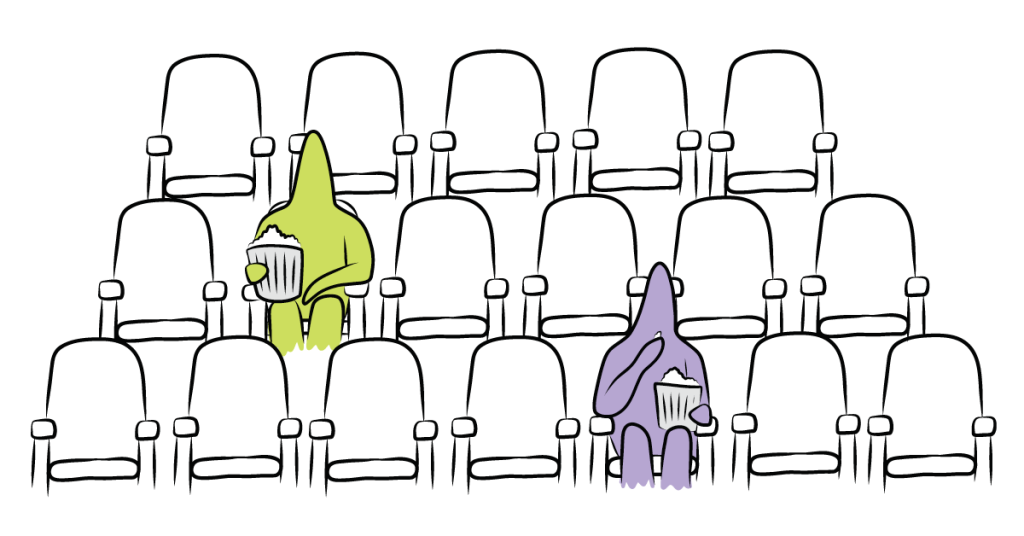
You walk into a theatre these days and they feel like ghost towns. It’s like, “did the rapture happen and I didn’t pray right or something”? This week’s illustration makes me wonder about what kind of firms might be the theatres of tomorrow.
So let’s experiment with this thought. Which segments of our field will thrive in the near future and which ones will slowly lose relevance?
Before I answer that question, I don’t think there’s a single “buggy whip” answer to that. In other words, however much at risk your particular niche might face, there’s always room for a winner. When the weakest kids get thrown off the increasingly faster merry go round, some kids will hang on…and they’ll have more space to maneuver and thrive. In other words, this isn’t existential, but it can help you adapt for the future.
The Strongest
Here are the elements I’d favor in any positioning:
- Data collection, and particularly zero- and first-party data. This might be information that you help a client collect, or maybe you help them analyze. It’s a very complex world and the attribution question is murkier—not clearer—than it has ever been. On top of that, we’re forced to navigate privacy concerns, and that makes this data more relevant.
- Conceptual creativity. Ideas. Things you can say in a few sentences. Statements that resonate with real humans at a soul level. It’s one of the things that consulting firms have never had, and fewer in-house teams master. It’s what holdcos only stumble on, once every 256 tries.
- Understanding normal humans that are not hyper online. We live in this very strange time where the hyper online people think everybody else is also hyper online, and the skilled people in this space are hyper online, which puts them at a disadvantage for understanding people who aren’t. Not everyone is embarrassing their kids on Facebook. If you watch CNN daily, you’re in a group that represents less than 1% of the population.
- Emotive storytelling. Not manipulative. Not always trying to sell something, but rather the kind of connection that only real humans make with their next door neighbors, only emulated in public.
- Hyper targeted marketing that eschews programmatic entirely and understands attribution in entirely new ways. This isn’t here yet in any real way, but somebody is going to figure out how to weave neglected methods (direct mail, anybody?) and non-interruptive digital, wrapped in compelling stories to sell real humans something from authentic people and companies. The hunger is there. The solutions aren’t there yet. I don’t even know what to call this, but advertising is so freaking ignorable these days, so devoid of humanity, so “spray and pray” and programmatic is at the top of that shit heap.
- Amateur spokespeople for brands, and by that I don’t mean influencers. I mean brands who find people who are already in love with their product or service and who are reluctantly willing to talk about it. A father who uses Legos to draw his son out, a widow who helps her neighbors with an ancient Ford tractor during harvest, a teenager who always sits in the same subway seat for some specific reason, etc.
- Live action production will always be here in the foreseeable future. Prices for animation might erode, but prices for live action will be strong, especially when coupled with expert scriptwriting, creative direction, sound, and editing.
The Most at Risk
On the other side, where would I be more hesitant? I’m not saying these won’t work, but rather that you have to acknowledge the long-term viability, the price pressure, or the aggregation stages:
- Software Platforms are notoriously friendly to experts (you) who help them attract clients to the platform. They work through you as their de facto sales team to help them find clients, and then they don’t need you as much and all the arrangements change. Think Hubspot, Shopify, WP, and dozens of others. If nothing else, recognize how decisions the platform makes might impact your firm.
- Small Firms. This is a tough one to write, just honestly, because I think your firm should be whatever size gives you, the principal, the role you want, so I want you to listen to your inner voice more than the screams from the marketplace, but the truth is that the only viable small firms are the tightly positioned ones. You’re a small generalist? Thoughts and prayers, my friend. And this is especially true of small dev shops that are not very tightly focused. More on that below.
- “Affinity” positioning, otherwise known variously as purpose-driven, non-profit, B-Corp, etc. While applauding the intentions behind the different phases of this movement, it’s more of an affinity driven by the supply side rather than a craved expertise from the demand side. There’s going to be some disruption here.
The Most Endangered Species
Here it is. I’m just going to say it. The most endangered species of firm out there is the small, generalist shop, but especially the small generalist dev shop. End of warning.
The Role of AI
It’ll be everywhere. The only differentiation that AI will provide is if you aren’t using it. It’ll be like a keyboard and mouse, or an internet connection. AI will not be a differentiator unless you aren’t using it. It won’t undercut your firm unless you aren’t using it. It will help you do the same job in less time, but that will just raise the stakes, and now you’ll do more for the same time and money and clients will expect it. AI will be a leveling force that just moves expectations.
There may be a one-time opportunity to bring your clients up to speed on it, but that will be one and done, and I pity the firm that treats AI adoption as the new digital transformation. It’ll be short-lived and not a game changer except in very small pockets with custom AI applications.
What to Do About It
Here’s how I’d plan for your future:
- Experiment with AI. Budget lots of time and money to learn.
- Ignore what I’ve said about the dangers of being a small firm, and be the size firm that yields the sort of role you, personally, want from your business.
- But if you land on “small”, make doubly sure that your positioning is very tight, because the equations are different.
- Solve the new business problem and sleep like a (good) baby at night.
Keep being resilient and keep reinventing yourself every two years.