How Proprietary Research Bolsters Positioning

I am obsessed with differentiation. Back in the early 90s, when I owned my firm, differentiation didn’t matter that much. A local client would pick a local agency, and the choice came down to capabilities and chemistry. But the internet demolished all those moats, and differentiation became absolutely critical in a sea of firms all vying for the same client pool.
I started developing some algorithms around this industry in the mid 90s, have taught countless seminars on it, written a book on it, and essentially led the industry in understanding how important it was, including the nuances of vertical and horizontal positioning, how too little and too much competition kills you, etc. Now, everybody talks about it, as they should.
But what do you do when a potential client narrows the choices from 55,000 firms (that’s roughly how many there are in the USA alone) to, say, a dozen? How do they make a sensible choice once 99.98% of the firms have been eliminated (that’s the real percentage)?
The Secondary Options
This is where there are many options to narrow down a choice, and the decision is always in the prospective client’s hands; they know what matters to them. But here are the most common decision points as they select one of the dozen or so firms in front of them:
- Size. Is it a deep enough bench?
- Service Offering Design. Do they have all the service offerings we want to buy together, from the same place?
- Location. This is seldom important, except in two cases: time zone and positioning resonance. For the latter, no one is going to pick an entertainment firm in South Dakota or a healthy ingredient F&B firm in Mississippi.
- How the relationship starts. Do they offer a clear diagnostic or roadmapping exercise, being transparent about the timing and cost?
- Case histories / past clients. Do I see myself as similar to some work they’ve done?
- Pricing. Do I like the way they think about pricing (fixed, recurring, sprints, etc.)?
- Reputation. What did that referral tell me about them? And what to watch out for?
- Proprietary Data. Do they collect and then apply proprietary data that I won’t find with other firms?
This last point is the one I want to explore a bit in this week’s article. And if you want to work on this together, be sure to join us in Atlanta for a full-day, small group workshop where we’ll apply it specifically to your firm (Aug 19; more info here).
Proprietary Data
I want to start by stating something that might pleasantly surprise you: most people overthink this and believe they need to have taken graduate-level courses in primary research methodologies and know their way around SPSS. This is far simpler than you probably realize, and here are the components of the ones that I see working well in the field already:
- It presumes that you are tightly positioned. That’s the only way that comparative data collection works, because the marketplace is sending you similar scenarios that invite comparison.
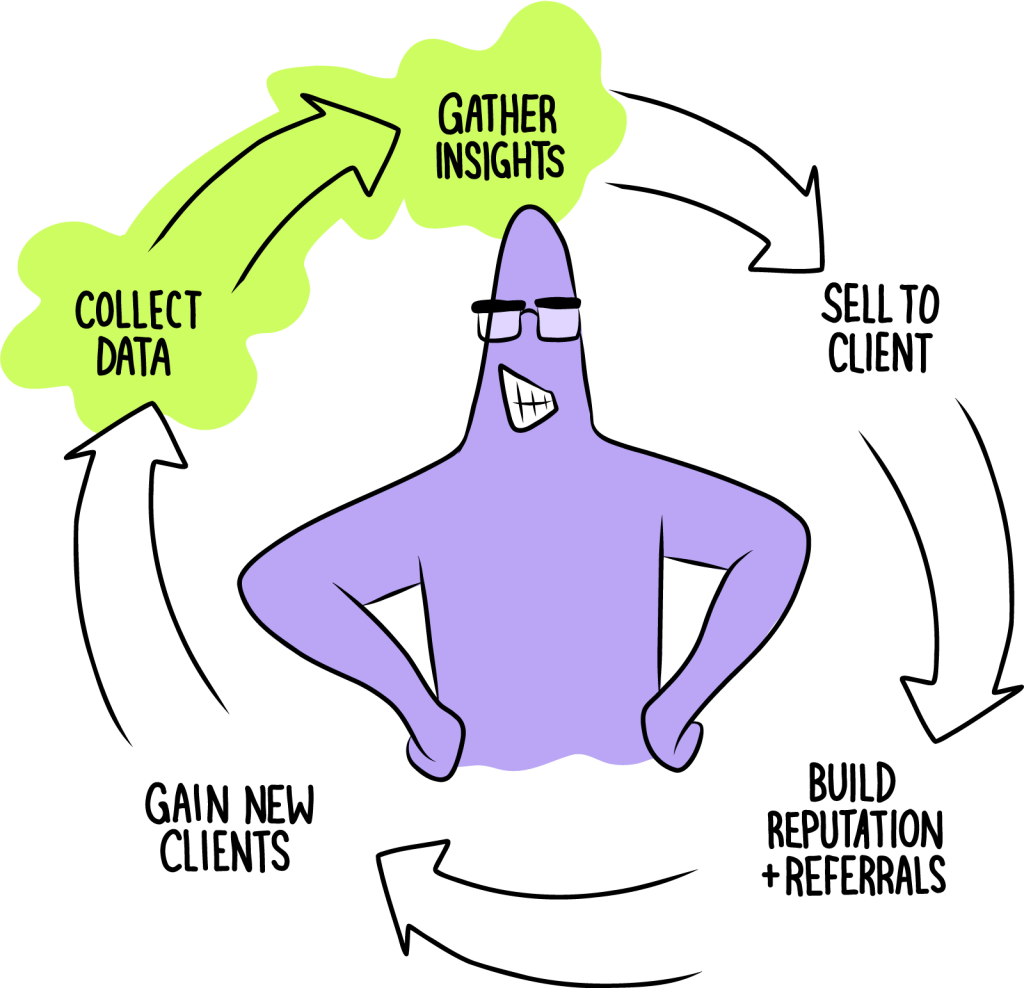
- You first collect the data from every client engagement. It might be from observation, surveys, or analysis of their own related data.
- You compare their data to your collected pool of data. This provides something to talk about, as well as specific gaps to close. You can track your progress by updating the same data, giving you a stickier relationship with the client.
- Good data collection does not depend on experience and intuition. The test is whether or not an intern can collect it. Interpreting the data requires experience; collecting it does not.
- Slowly, various algorithms will appear and you’ll know what X + Y, with a little bit of Z means. This allows you to diagnose quicker and more reliably.
- When you’re collecting the same data from different levels within the organization, one of the most interesting findings will be the perception gaps: “leaders think we are doing pretty well along this axis, but the public-facing team doesn’t agree.”
- You’ll want to name this data model and protect the IP.
- You might want to enlist a partner to help collect and/or synthesize it. One of my favorite ways to do that is to partner with a university department that’s related to your market focus, and let TAs (teaching assistants in Ph.D. programs who need and want real-life projects) do the work with you. If you’re focused on the ag world, you might work with Purdue, or if you’re focused on tech, you might work with Stanford.
- Whether you employ assistants or not, a regular comparative release of the most recent data from across your clients—and maybe even across a broader segment—is exactly the sort of thing that’s ready-made for publicity in trade pubs and so on. If nothing else, it’s fodder for your own email distribution list.
Examples
Here are some real world examples to get you thinking.
One firm reverse engineered the NPS (net promoter score) to measure the strength of internal culture to help in their internal branding and comms work.
Another firm analyzed hundreds of reporters’ questions in press conferences to anticipate the likely order/sequence of the next question, helping the people at the front be prepared.
One firm developed a scientific model to predict how regular consumers in the flyover states would evaluate classic brands.
Yet another developed a way to test product packaging in real time on Amazon.
A firm that helps non-profits create real change among various constituent populations tied their work to an established “theory of change” to help the client understand the more effective methods they could use.
And finally, a startup from the advertising world has developed (and protected) a methodology to measure brand value, which advertisers can use to demonstrate their impact.
We, too, have done this for many years and it’s the cornerstone of our advisory and M&A work. I hope you’ll join us in starting to build an ownable data model for yourself. It’s one of the very easiest ways to differentiate yourself in the marketplace.