The Power of Competitive Bids

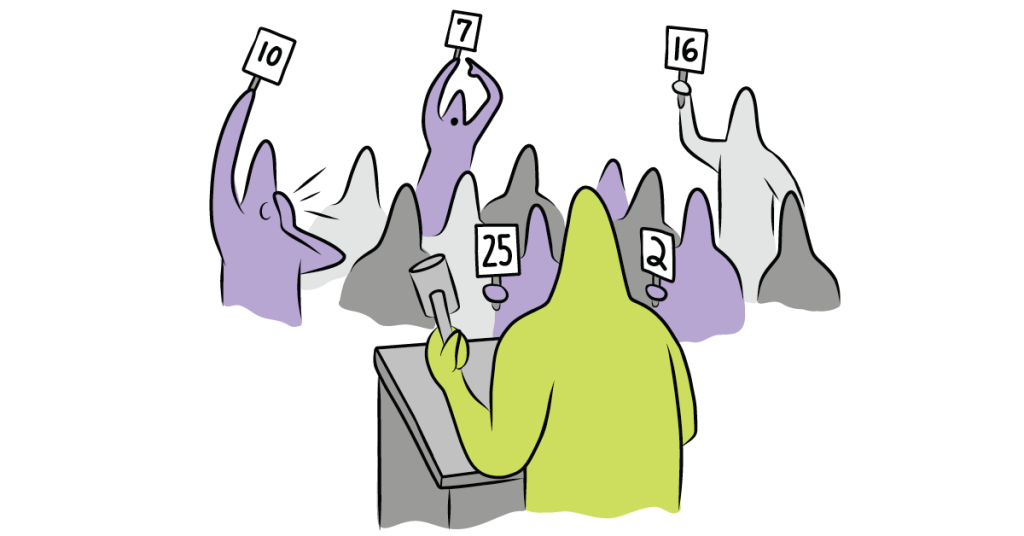
We live on a 61-acre farm outside Nashville, and our neighbor recently sold 70 acres, some of which adjoined our property. There was a public auction one spring morning, and so we had to decide how high we’d be comfortable bidding up the land right next to us. We thought we’d be comfortable at $30k/acre and were pretty excited that we might get it.
More than 200 people showed up that morning a year ago, and about 30 placed bids. It unfolded in just a few short minutes, and the plot we had our eye on went for $40k/acre. We never even raised our bidder’s paddle once! The crowd blew past our target before we could even revisit our target price, and now we have a new neighbor.
An Early Client Memory
The same thing happens when you sell your firm. There was a firm in Texas who had an offer in hand from a big agency in Missouri. The principal talked with a financial advisor, asking for an opinion on how fair the offer was. The advisor wasn’t sure, and suggested that they call us, even though it was late in the process.
We did a quick check and thought the offer was low, and so we suggested that they let us find some competitive offers, since the tentative buyer had approached the seller and no search had occurred. They agreed, and we went to work.
We found three additional written offers, all of which were in the ballpark of what we thought was fair. The seller took those back to the original buyer, and in an interesting twist, the original offer was doubled. The sale went through, to the same buyer, and everyone was happy. Well, happy enough.
The Better Way
This scenario unfolded in a way that’s not really optimal. There are times, of course, when that single buyer makes a fair offer and the stars align perfectly and you know it’s the right deal. But if you aren’t an experienced seller, how are you going to know? You could have someone take a look at the purchase price and terms, but it’s disruptive to start all over again to find competing offers. And sometimes the buyer isn’t as excited about that process as you might be.
The better approach is to find competing offers out of the gate. In two recent examples, we were able to find as many as five bidders for firms we were representing. This puts everyone on an even footing from the start without slowing the process for several months, later in the game.
Doubling an initial offer is not typical, but finding multiple buyers can easily increase the selling price and improve the terms by 20-60%, on average.
Important Note: the NDA
There’s an important point to make, here, and it dovetails with our philosophy of negotiating as much of the deal as possible into the LOI…and not after the LOI is signed. Why?
First, doing it before the LOI means that you’re dealing with a serious buyer. The unserious buyer issues LOIs all over the place and then decides which of those firms to buy, wasting your time.
Second, once you sign an LOI, you can’t typically entertain other offers; much less search for them. So it’s important to put that off until the deal is one that you’d likely be happy with. That means you need options before you make that decision.
Without multiple buyers at the auction, we might have gotten the land for $30k/acre, but the seller would have lost out.
You don’t engage an M&A firm to find a buyer—you engage them to find multiple interested parties so that you can find the best buyer, which doesn’t just mean price. It also means terms and culture.