Pricing Data Comes Best from Conversations

I want to talk about one feature of market feedback in your pricing, but let’s first put a little historical context around this topic.
Advantages of Productization
There’s a welcome mini movement afoot in the creative fields, and that’s the notion of greater productization. When that happens, selling is easier, there’s less time spent on custom proposals, project management is more efficient, and onboarding new team members is smoother (to allow less dependence on the senior team). All of this is true, and you should experiment with it, at least for one or two of your service offerings.
Where Productization Lags
Although I’m a huge fan of productization (you can see it on our own website—scroll down here), there’s one thing you really have to be careful about, and it’s this: it can smother pricing signals.
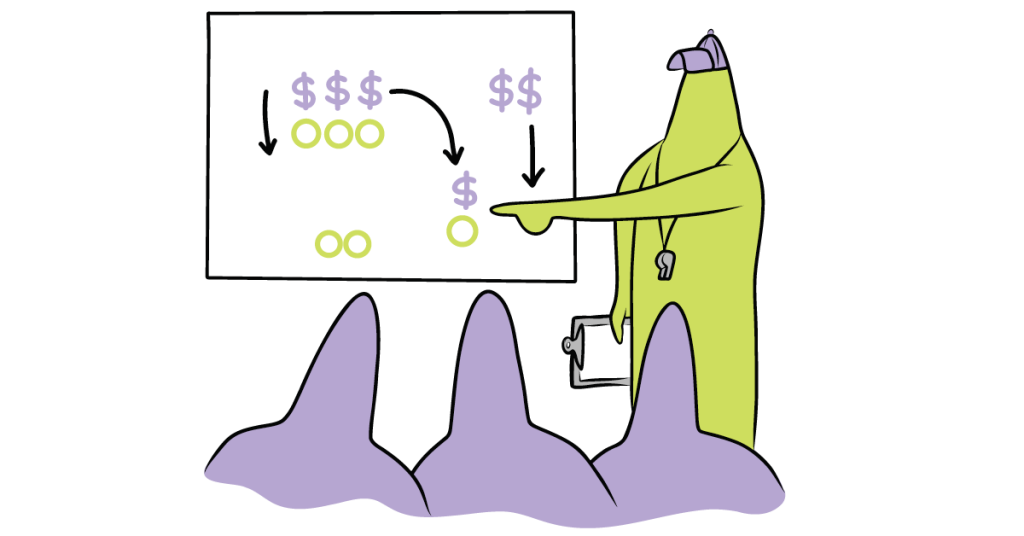
By that I mean that you don’t get the sort of feedback that a free market would otherwise provide on pricing. A prospective client will accept your proposal or not, and neither of those options tells you about whether the price was optimized. On the electronic board, either the Accepted or Not Accepted light flashes; not Too High or Too Low.
The Role of the Market
I’m not going to pretend to be the pricing expert around here, and in fact I’m going to leave that to my 2 Bobs co-host, who’s actually written a book on it. I didn’t even stay at a Holiday Inn last night, but I did listen very intently to a recent podcast where Russ Roberts interviewed Peter Boetke.
In that episode, both of them summarize the very essence of Hayek’s argument about free markets:
- The fact that we have property rights gives us an incentive to own things.
- Prices in the free market provide the most accurate information on value.
- The promise of additional profits encourages us to partake in innovation.
- The real danger of losses provides market discipline.
So there you have it: property, prices, profits, and losses. To look further into how price systems give us the information we need, Claude summarizes Hayek’s theory like this:
This is perhaps Hayek's most influential insight, articulated brilliantly in his 1945 essay "The Use of Knowledge in Society." He argued that the fundamental economic problem isn't how to allocate given resources optimally (as conventional economics assumed), but rather how to utilize knowledge that exists dispersed among millions of people, each possessing unique, local, often tacit knowledge of "particular circumstances of time and place."
Prices solve this "knowledge problem." When tin becomes scarcer somewhere in the world, users don't need to know why—they only need to see the price rise to economize on tin or substitute alternatives. Prices distill vast amounts of information into a single number that guides behavior. This makes central planning impossible—no planner can possess or process the dispersed knowledge that the price system handles automatically.
This provides one of the counter arguments to productization. This notion of central planning they are referring to is a socialist government, but a variant of that is when you pop into a Slack group of peers and ask what they are charging. That tells you what they are charging and not what you should be charging.
Where Productization Fails
A price gives us information, but not a summary of past costs, and Hayek says that pricing is a guide for us to engage in future activity. This knowledge that is embedded in the price system is only revealed in engaging in the act of exchange. (And “the act of exchange” is always actual conversations, give and take, with prospects.)
You can look at your hours and see what your cost is. You can survey your peers to see if you are in the ballpark. But none of that is useful information about what the market will bear.
This is also why you get no information when all of your prices are accepted…except that they are probably too low! I’ve often said offered this very rough rule of thumb when it comes to your pricing: as soon as you get comfortable that prospects will buy something for X amount, you need to raise the price for the same deliverable. Ideal pricing always has you a tad nervous. That’s the goal.
Bottom Line
You absolutely should experiment with productization, but you should never totally avoid actual conversations about value with prospective clients. The signals you get from people who want to buy from you are far more important than your costs and what other people are charging, which are far too lemming-like.