Do Independent Firms Need A Board?

Punctuation serves independent firms (advertising, design, PR/PA, dev, digital, etc.) The key distinction there is “independent” firms, which really means that the principal doesn’t have a boss.
So what are the forces that influence that principal’s behavior?
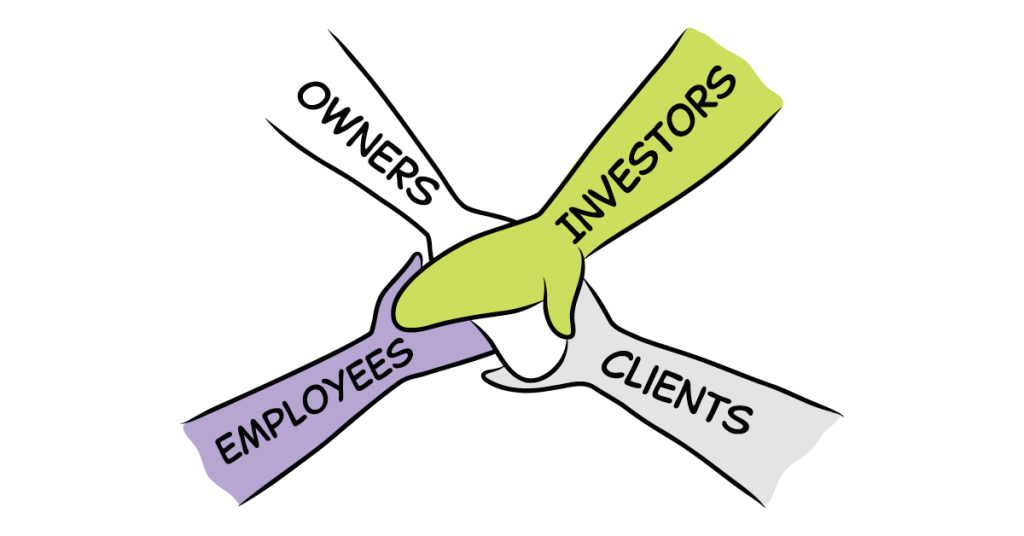
- Other partners, if there are any, that contribute to the process of building leadership consensus.
- Free market labor, where anyone in a post-13th amendment world is free to accept employment elsewhere.
- All the clients, who are little “bosses” of a sort. I’ve joked that quitting your job and starting a firm is exchanging one boss for a dozen.
- Investors, which are rare in this space, because the investor is usually the principal.
Role of Investors
I’ve done direct consulting for Adobe, Whole Foods, Toyota, Price Waterhouse, TIAA-CREF, Compassion Intl, Verizon, Hartford Life, T. Rowe Price, Cisco, Northwestern, Thomson Reuters, and Vanderbilt. The people were wonderful, but I felt like I was scooping sand on a beach. I don’t do that anymore and don’t miss it at all, though I have served on quite a few boards.
It wasn’t until I went through the certification training of the National Association of Corporate Directors, though, that I fully understood the pressure those organizations were under. The biggest difference in those settings is that they are not independent: the executives that run the publicly traded companies do indeed have a boss, and that boss is the board. What’s the board’s role? To protect the investors. Period.
In an independent firm, the investor is the principal, and thus there’s no separate boss other than the influences I’ve noted above.
Protecting the Firm from the Principal
I know. That subhead right there is a strange way to picture this challenge, but it sits at the heart of the strange world of independent firms. Who protects the principal from himself or herself? And who protects the others?
Here’s where a little bit of history is useful.
The first boards were comprised of private shareholders who provided the capital to the companies. Their interests were aligned with the managers. It was the investors’ money, but the investors needed a leader to make the investment meaningful.
Over time, the companies became so successful…and large…that funding eventually came more from the public markets, and so there was an incentive issue because the shareholders weren’t large enough to vote themselves onto the board, usually, and the managers just grabbed their friends and so on, and the interests diverged.
The checks and balances then came from the hostile takeover market. “If your company doesn’t perform, your stock price will drop, we’ll take the company over against its wishes, and we’ll replace you very, very bad managers.”
That’s when poison pills and anti-takeover procedures rose, and, again, companies were unchecked, without accountability.
Then investors merged their interests with institutional entities, which were investing for other people (unions, retirement, but especially the two big proxy advisory firms) and they wanted accountability. They fought anti-takeover procedures and wanted to revitalize board constitution.
They wanted:
- Managers to have long-term incentives (stock).
- Independent boards who could exercise control over managers (fire them).
- And at times, directors who may have a financial stake in the outcome because they represent a large group of investors (get a seat on the board).
That’s the history of publicly traded companies, and how slowly they came to align incentives and create proportional wealth: “if I, as a shareholder, purchase shares of your company, I want you to reward that investment.” There are still bad incentives in the system (false signals in share prices, investments off the balance sheet, self-dealing, etc.), but it’s much better than it was.
Operating Without Boards
How does this apply to your firm? Your employees walk if you’re a bad manager. Your clients walk if you don’t do good work. Your funding dries up if you don’t manage cash or debt well. If you violate legal frameworks, you might get caught and punished.
Essentially, though, it’s only the marketplace that’s correcting your bad behavior as a boss. There’s no independent, authority-infused advisory board that can course correct before it’s too late, and that’s exactly why so many firms go out of business, churn through staff, lose clients, and act like student drivers in an F1 race.
It can be a mess, but there are better alternatives.
The Alternatives for Independent Principals
One solution is to have a partner. That’s not a foolproof solution, but it can really help. It can save you from yourself, especially if your operating agreement includes a mechanism for throwing a bad partner out. More on the pros and cons of partnership here.
Another solution is to have an open-book arrangement with a few trusted principals who all operate their own firms. We have that at Punctuation with four other firms, and each of us is totally transparent about their performance and challenges.
Yet another solution is to have an advisory board, but not one staffed with a neighbor down the street who ran an unrelated firm, your uncle who was a mediocre CPA, and an ex client you still want to impress. No, these board should be a mix of professionals who know the inside of expertise-driven service business, and their participation should be formalized and paid. There are regular meetings, agendas, votes, and retained historical records.
For smaller and younger firms, I’d recommend an informal open-book arrangement. But for more serious firms, I would recommend a formal advisory board. It should be staffed with 2-4 additional people besides the principal(s), and they should be charged with addressing issues like these:
- Business strategy.
- CEO evaluation, culture, leadership.
- Finance: performance targets and debt.
- Succession/M&A planning, both for the firm itself and for key players who are integral to operations, accounting for SPF (single points of failure).
- HR and employment.
- Risk management.
They would meet in person yearly, with monthly reporting and quarterly virtual gatherings. The board president should be paid ($20-40k/year for a smaller company and much more for a larger one), and the other members can be paid expenses only, depending on the situation.
You’re an independent owner with personal agency. But external guidance should always be welcome.